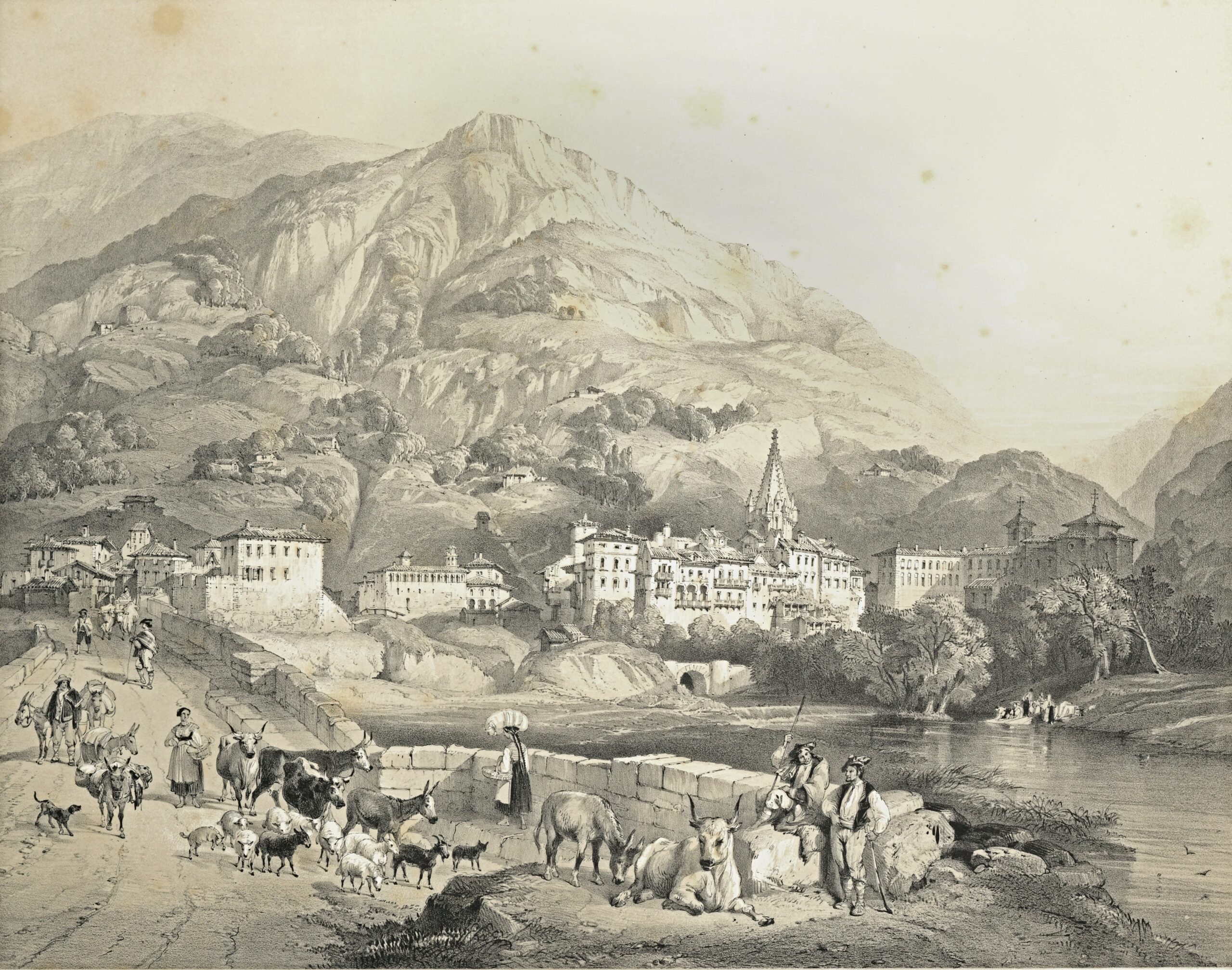
Azpeitia en Guipuzcoa desde el Camino de Tolosa
Adolphe Rouargue after Genaro Pérez Villaamil, 1850
Lithograph
David Roberts’s artist-friend Genaro Pérez Villaamil (1807-1854) teamed up with a Spanish writer (Patricio de la Escosura), a prestigious Parisian publisher (Albert Hauser) and a fleet of lithographers to produce España artística y monumental (1842-50), a three-volume album of 144 lithographs with commentaries in Spanish and French. Motivated by cultural nationalism, Villaamil and Escosura aimed at instructing Spanish and foreign readers in the ‘character of the Spanish nation’. The first two volumes (1842, 1844) were produced while Villaamil lived in self-imposed exile in France and Belgium. After returning to Madrid, he was appointed to the inaugural Chair of Landscape Painting at the Real Academia de Bellas Artes in 1845. He undertook several sketching tours through Spain to supply his publisher, Albert Hauser, with drawings for the third volume of España artística y monumental (1850). The print shown here is part of this volume and focuses on central and northern regions in Spain to counter the foreign tendency to associate Spain with Andalucía.
Escosura uses his commentary on this lithograph of Azpeitia to chide his fellow countrymen for staying at home rather than venturing out to enjoy the stunning scenery in this part of the country, where they would find ‘… una naturaleza poderosa, una vegetación exuberante, magníficas perspectivas, donde no faltan ni el monte gigantesco, ni el silencioso valle, ni la accidentada rambla, ni el torrente mugidor, ni el blando arroyuelo’ [powerful nature, exuberant vegetation, magnificent perspectives, with no lack of huge mountains, silent valleys, rugged ravines, roaring torrents or gentle streams].
Azpeitia is best known today as the birthplace of Saint Ignatius Loyola (1491-1556), one of the founders of the Jesuit order, expelled from Spain in 1767. Villaamil visited Azpeitia from Tolosa on 3 September 1844 and drew this view across the river Urola with Mount Izarri in the background. The tower is that of the parish church behind a very striking range of sixteenth-century houses with arched windows and the monastery of Santo Domingo to the right.
Title: Azpeitia en Guipuzcoa desde el Camino de Tolosa | Vue d’Azpeitia dans le Guipuzcoa prise du chemin de Tolosa.
Author/Artist: Adolphe Rouargue (1810-1884, lithographer) after Genaro Pérez Villaamil (1807-1854, artist).
Technique and Material: Lithograph.
Dimensions: 310 x 395 mm (image) 525 x 375 mm (page).
Published: Plate 125 from Genaro Pérez Villaamil and Patricio de la Escosura, España artística y monumental. Three volumes. Paris: A Hauser, 1842-50. Volume 3.
Date: 1850.
Marks and Inscriptions: lower edge, left: ‘G.P.de Villa-Amil dibujó’ / ‘Paris – chez A Hauser Boul des Italiens, 11’; centre: title as above; right: ‘Rouargue lith.’ / ‘Imp. Lemercier à Paris’.
Institution: Barry Ife Collection.
Click to zoom and pan
...
Your feedback is very important to us. Would you like to tell us why?
We will never display your feedback on site - this information is used for research purposes.
Details
Title
Azpeitia en Guipuzcoa desde el Camino de Tolosa.
Artist
Adolphe Rouargue (1810-1884).
Date
1850.
Medium and Support
Lithograph.
Dimensions
310 x 395 mm (image) 525 x 375 mm (page).
Marks and Inscriptions
lower edge, left: ‘G.P.de Villa-Amil dibujó’ / ‘Paris – chez A Hauser Boul des Italiens, 11’; centre: title as above; right: ‘Rouargue lith.’ / ‘Imp. Lemercier à Paris’ .
Institution
Barry Ife Collection
Plate 125 from Genaro Pérez Villaamil and Patricio de la Escosura, España.