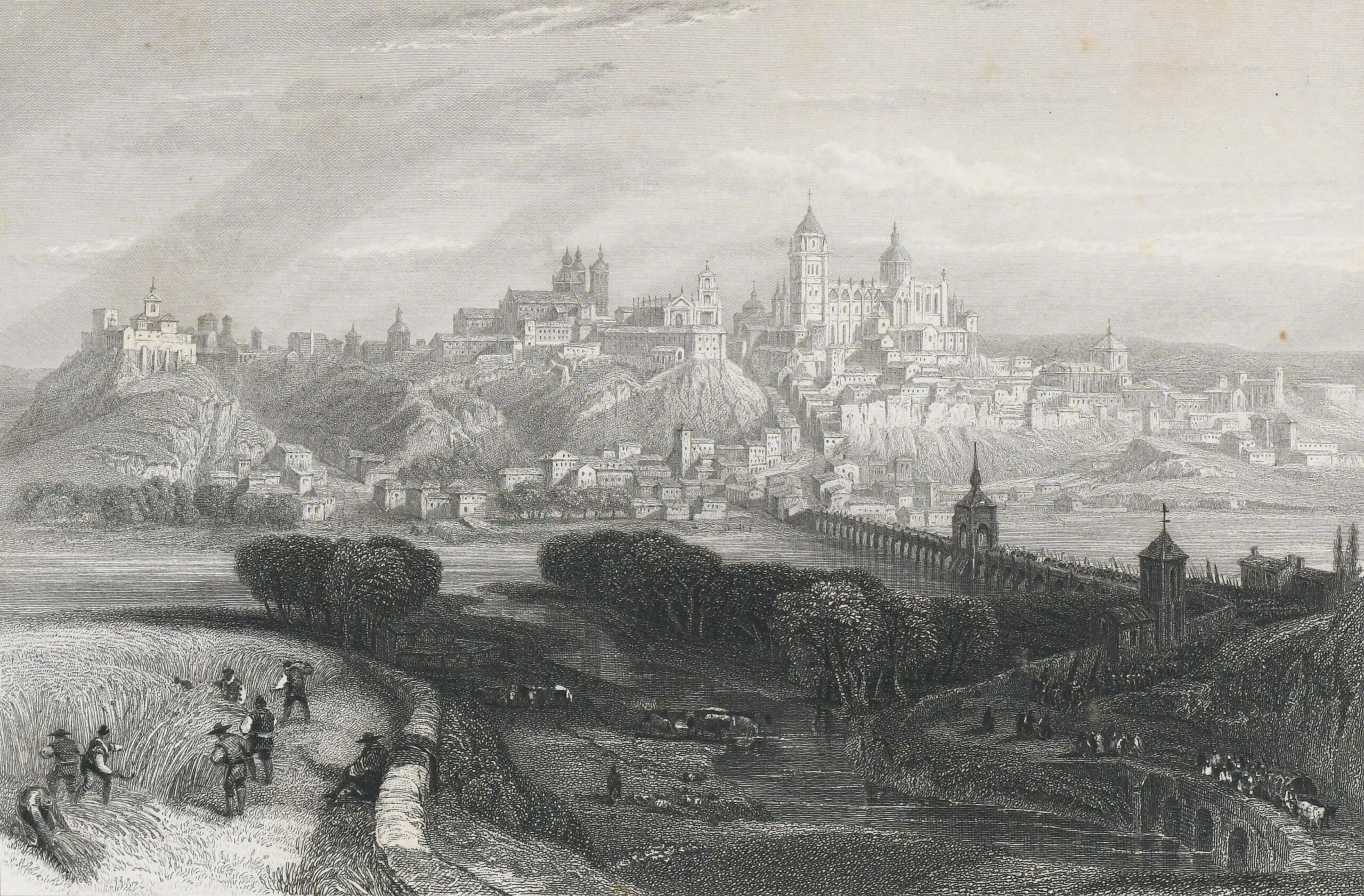
Salamanca
James Tibbits Willmore after David Roberts, from a sketch by Richard Ford, 1838
Steel engraving
David Roberts was unable to visit Salamanca in person during his tour of Spain in 1832-1833 as his visit was cut short in September 1833 by a cholera outbreak in Seville. But when commissioned to illustrate four volumes of Jennings’ Landscape Annual (1835-1838) Roberts had to rely on a sketch made on the spot by Richard Ford in June 1832. Ford made several sketches of Salamanca during his stay but Roberts chose this classic view from the opposite bank of the River Tormes as the basis of his illustration.
The view shows an impressive cityscape dominated by historic architecture. Many of the buildings are constructed from local honey-coloured sandstone that glows in bright sunlight, giving the city its nickname ‘La Dorada’. In 1988 the old city was declared a UNESCO World Heritage site.
The most prominent features are the two cathedrals. The old cathedral (Catedral Vieja) was built between the 12th and 14th centuries in Romanesque style with some Gothic elements and features a distinctive fortress-like appearance with thick walls and modest windows. Immediately adjacent and physically connected stands the new cathedral (Catedral Nueva), built between the 16th and 18th centuries to accommodate a rapidly-growing city. This cathedral was built in late Gothic style with Renaissance and Baroque decorations and an ornate façade featuring intricate stone carvings and numerous sculptures.
In his commentary on Salamanca (Spain and Morocco, 1838) Roscoe records that he thought Salamanca ‘anything but grave and dull, affording us a continual succession of sights’ (p. 81). He was greatly taken with the liveliness of the Plaza Mayor that doubled as a bullring, and particularly enjoyed the bustle in the streets, with the ‘noble students, lounging in their thread-bare gowns, smoking or wrangling like so many roisterous idlers’ (p. 79). But he found little to praise about the cathedral, calling it ‘a stupendous specimen of the modern gothic, but executed in no good taste’ (p. 71).
Also visible in the engraving are the façade of the Convento de San Esteban and the Renaissance spire of the university, founded in 1218 and one of the oldest universities in Europe. In the right foreground stands the Roman Bridge, constructed in the first century CE during the reign of the Emperor Trajan, now pedestrianised. Fifteen of its twenty-six arches are of original Roman construction. This timeless view, one of the most beautiful in all Spain, is virtually unchanged in the nearly two centuries since this engraving was made.
Title: Salamanca from above the river Zurguen.
Author/Artist: James Tibbits Willmore (1800-1863, engraver) after David Roberts (1796-1864, artist), from a sketch by Richard Ford (1796-1858).
Technique and Material: Steel engraving on paper.
Dimensions: 94 x 143 mm.
Published: Plate [3] from Thomas Roscoe, The Tourist in Spain and Morocco. Illustrated from drawings by David Roberts. London: Robert Jennings & Co, 1838, facing page 80.
Date: 1838.
Marks and Inscriptions: lower edge, left: ‘Drawn by David Roberts from a sketch by Richard Ford Esq’; centre: title as above / ‘London, Published Oct. 28th 1837, by Robert Jennings & Co 62 Cheapside’; right: ‘Engraved by J.T. Willmore’.
Institution: Barry Ife Collection.
Click to zoom and pan
...
Your feedback is very important to us. Would you like to tell us why?
We will never display your feedback on site - this information is used for research purposes.
Details
Title
Salamanca.
Artist
James Tibbits Willmore (1800-1863).
Date
1838.
Medium and Support
Steel engraving on paper.
Dimensions
94 x 143 mm.
Marks and Inscriptions
lower edge, left: ‘Drawn by David Roberts from a sketch by Richard Ford Esq’; centre: title as above / ‘London, Published Oct. 28th 1837, by Robert Jennings & Co 62 Cheapside’; right: ‘Engraved by J.T. Willmore’.
Institution
Barry Ife Collection
Plate [3] from Thomas Roscoe, The Tourist in Spain and Morocco. Illustrated from drawings by David Roberts. London: Robert Jennings & Co, 1838, facing page 80. Date: 1838 .