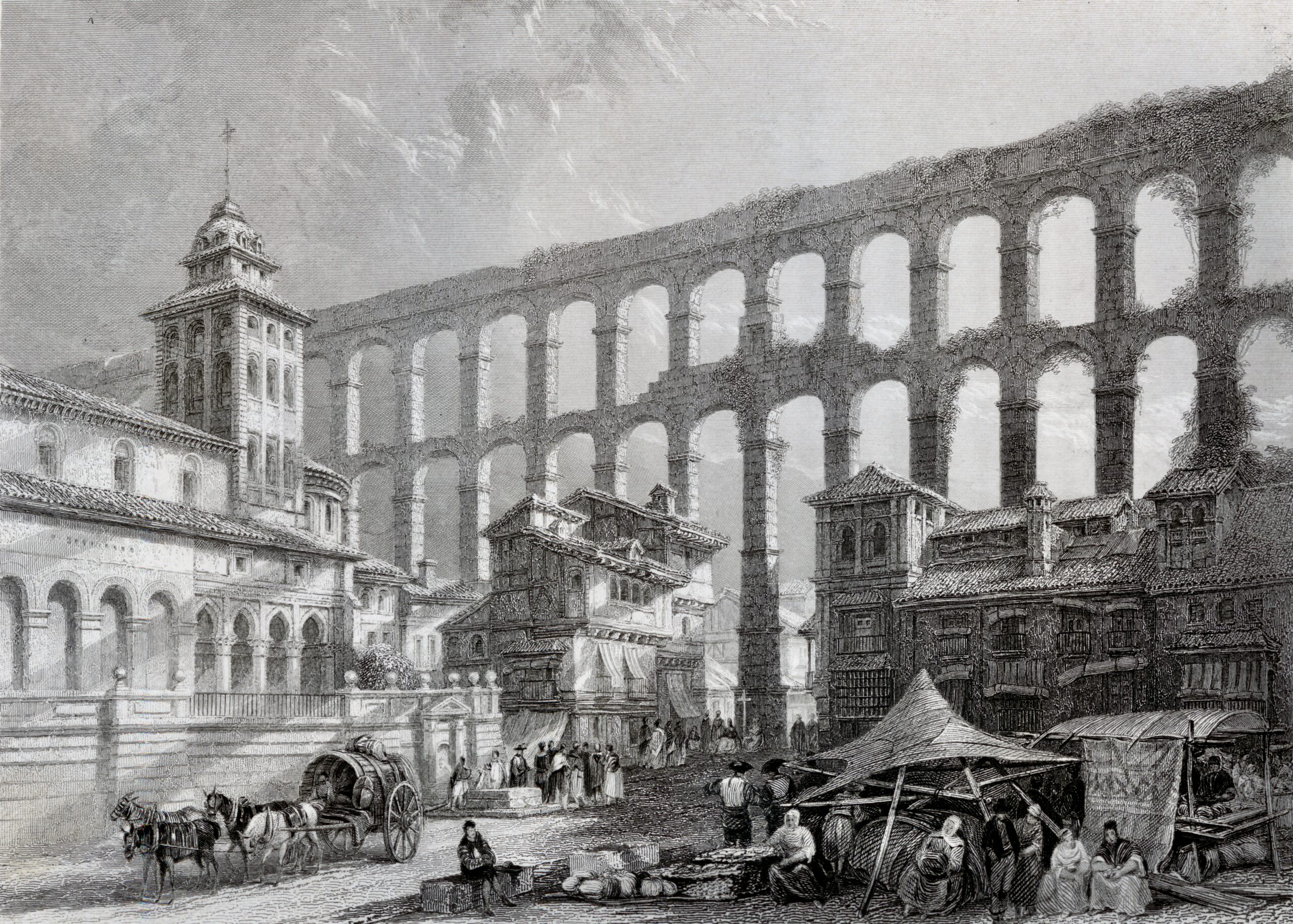
Great Roman Aqueduct at Segovia
James Charles Armytage after David Roberts, 1837
Steel engraving
The Roman aqueduct at Segovia is one of the principal landmarks in Castile, is a UNESCO World Heritage Site and is a must-see feature for any visitor to this part of Spain. It was built in the first century CE—begun under the Emperor Domitian (81-96) and completed under the Emperor Trajan (98-117)—for the purpose of bringing water to the city from mountain springs over a distance of 11 miles.
The bridge section of the aqueduct, pictured here from what is now the Plaza del Azoguejo, is 740 yards long, nearly 100 feet high at its highest point, and consists of 167 arches on two levels. It is one of the best preserved Roman aqueducts and was still in use at the time that this engraving was published. Roberts did not visit Segovia himself, as his journey was cut short in mid-September 1833 by an outbreak of cholera which left him with no option but to return directly to London from Seville. To create the drawing for this engraving, Roberts relied on a sketch by one of his friends, possibly Lieutenant J. Edridge or Lieutenant Smith in the Royal Artillery, or Colonel Harding of the Royal Engineers.
Roscoe thought that this scene represented Segovia’s ‘most striking phasis…where one of the great streets of Segovia, running from south to north, passes through two arches under the aqueduct and has on one side, a cluster of private dwellings, on the other a church’ (The Tourist in Spain: Biscay and the Castiles, p. 106). The ramshackle tenements contrast sharply with the church on the left and echo those that Roberts drew against the walls of Burgos cathedral (3.2). But Roscoe disapproved of the vegetation on the aqueduct: ’Creeping plants, climbing about its arches, twisting themselves about the piers, and drooping beautifully from the moist parapet above, improve, no doubt the picturesque features of this remnant of the taste of republican Rome, but they injure while they adorn. For the roots…introduce the first principles of decay, and, if not in time removed, will end by bringing this splendid monument to the ground’ (p. 107).
Title: Great Roman Aqueduct at Segovia.
Author/Artist: James Charles Armytage (1802-1897, lithographer) after David Roberts (1796-1864, artist).
Technique and Material: Steel-engraving on paper.
Dimensions: 94 x 122 mm.
Published: Plate [12] from Thomas Roscoe, The Tourist in Spain: Biscay and the Castiles. Illustrated from drawings by David Roberts. London: Robert Jennings & Co, 1837, facing page 106.
Date: 1837.
Marks and Inscriptions: lower edge, left: ‘Drawn by David Roberts’; centre: title as above; right: ‘Engraved by J.C. Armytage’.
Institution: Barry Ife Collection.
Click to zoom and pan
...
Your feedback is very important to us. Would you like to tell us why?
We will never display your feedback on site - this information is used for research purposes.
Details
Title
Great Roman Aqueduct at Segovia.
Artist
James Charles Armytage (1802-1897).
Date
1837.
Medium and Support
Steel-engraving on paper.
Dimensions
94 x 122 mm.
Marks and Inscriptions
lower edge, left: ‘Drawn by David Roberts’; centre: title as above; right: ‘Engraved by J.C. Armytage’.
Institution
Barry Ife Collection
Plate [12] from Thomas Roscoe, The Tourist in Spain: Biscay and the Castiles. Illustrated from drawings by David Roberts.London: Robert Jennings & Co, 1837, facing page 106. .