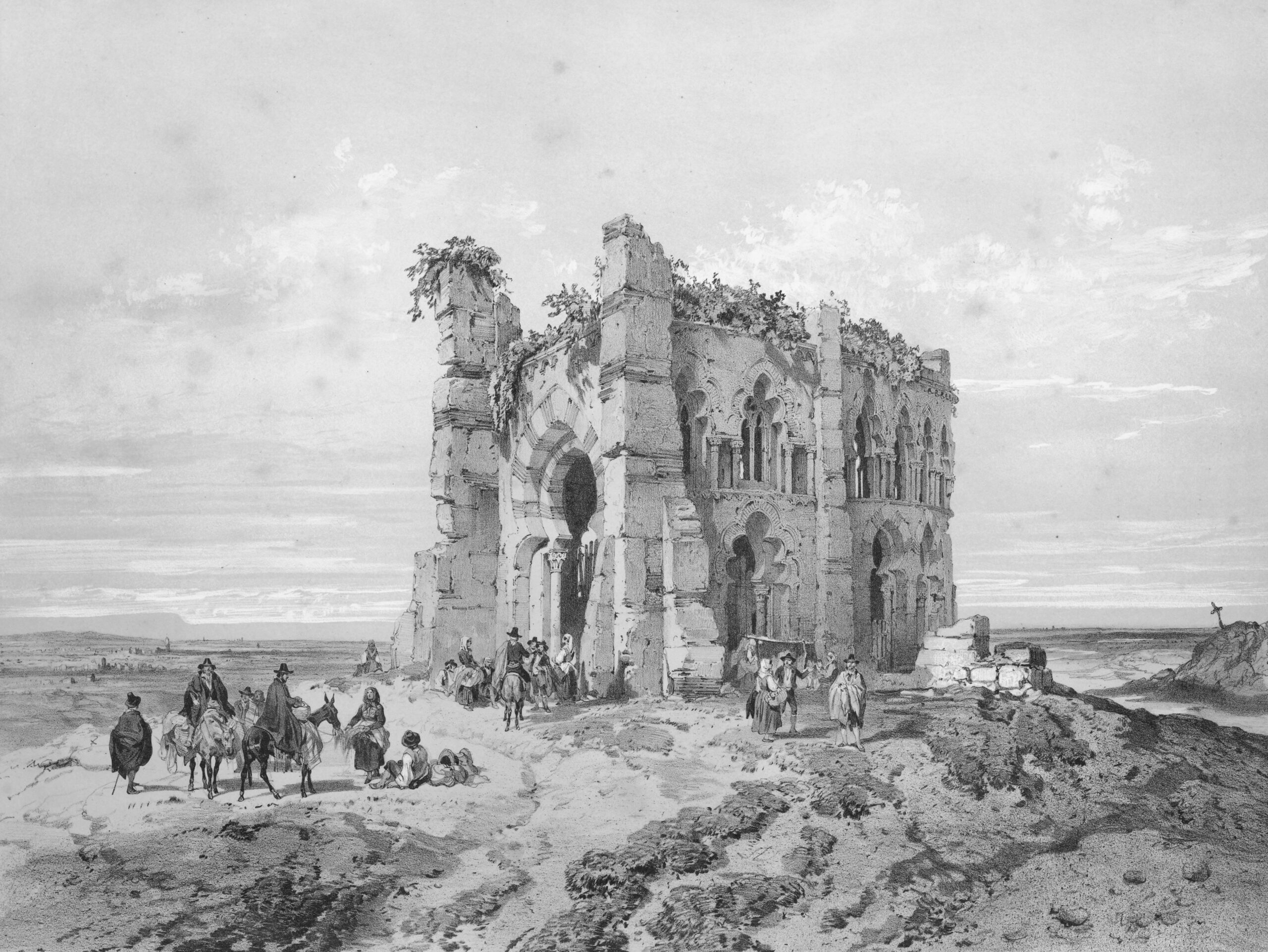
Ruinas Árabes en Humanejos
Léon Jean-Baptiste Sabatier and Auguste Mathieu after Genaro Pérez Villaamil, 1850
Lithograph
The view depicts a ruinous mudéjar church, no longer extant, in the surroundings of Humanejos, about 20 km south of Madrid. Villaamil’s preparatory drawing for this lithograph is annotated with the phrase ‘interesting fragment ancient Mozarab basilica 9th century’. When the drawing was turned into a lithograph for España artística y monumental, published in Paris, the image was given an unambiguously exotic title: ‘Ruinas árabes en Humanejos’. Yet the accompanying commentary, written by Escosura and Villaamil, was titled ‘Ruinas de una antigua Basilica, estilo Arabe-Bizantino’ [Ruins of an old basilica, in the Arabic-Byzantine style]. The different titles reveal their uncertainty about the history of the monument. Villaamil speculates that it was a mosque, converted into a church under Alfonso VI of León and Castile. He connects its architectural style to the fabled palatial city of Medina Azahara near Córdoba (excavated in the 1960s), representing the height of Umayyad architecture.
Villaamil can only describe how this building might have looked, with its beautiful arches resting on marble columns, which can still be appreciated in his Romantic rendering, almost like a folly. He laments, ‘hoy es una miserable ruina en un árido desierto y que pasa desapercibida a los ojos de casi todos los viajeros, y tal vez, al escribir estas lineas, habrá sido completamente arrasada.’ [Today it is a miserable ruin in an arid desert disregarded by nearly every traveller, and perhaps, as I write these lines, it will have been completely razed.] How right he was, though this handsome ruin clearly did not go unnoticed by the twenty or more Spanish tipos for whom it made an attractive meeting point.
In 1855, the Scottish architectural historian James Fergusson reproduced Villaamil’s view as a woodcut in his Illustrated Handbook of Architecture (1855). It featured twice in his book: as the frontispiece for the second volume, and in the section on Spanish architecture. This image was also reproduced in his later A History of Architecture in All Countries (1874), where Fergusson referred to it as a ‘little chapel’ and ‘picturesque example’ that might ‘almost be mistaken for an example of pure Saracenic architecture’.
Title: Ruinas Árabes en Humanejos | Ruines Arabes à Humanejos.
Author/Artist: Léon Jean-Baptiste Sabatier (1827-1887) and Auguste Mathieu (1807-1863, lithographers) after a drawing by Genaro Pérez Villaamil (1807-1854, artist).
Technique and Material: Lithograph on paper.
Dimensions: 300 x 400 mm (image), 525 x 375 mm (page).
Published: Plate 97 from Genaro Pérez Villaamil and Patricio de la Escosura, España artística y monumental. Three volumes. Paris: A Hauser, 1842-50. Volume 3.
Date: 1850.
Marks and Inscriptions: below the image, left: ‘G. P. de Villa-Amil dibujó’; centre: title as above; right: ‘MM Sabatier et Aug. Mathieu lith.’
Institution: Barry Ife Collection.
Click to zoom and pan
...
Your feedback is very important to us. Would you like to tell us why?
We will never display your feedback on site - this information is used for research purposes.
Details
Title
Ruinas Árabes en Humanejos.
Artist
Léon Jean-Baptiste Sabatier and Auguste Mathieu after Genaro Pérez Villaamil (1809-1854) .
Date
1850.
Medium and Support
Lithograph on paper.
Dimensions
300 x 400 mm (image), 525 x 375 mm (page).
Marks and Inscriptions
below the image, left: ‘G. P. de Villa-Amil dibujó’; centre: title as above; right: ‘MM Sabatier et Aug. Mathieu lith.’.
Institution
Barry Ife Collection
Plate 97 from Genaro Pérez Villaamil and Patricio de la Escosura, España artística y monumental. Three volumes. Paris: A Hauser, 1842-50. Volume 3. .