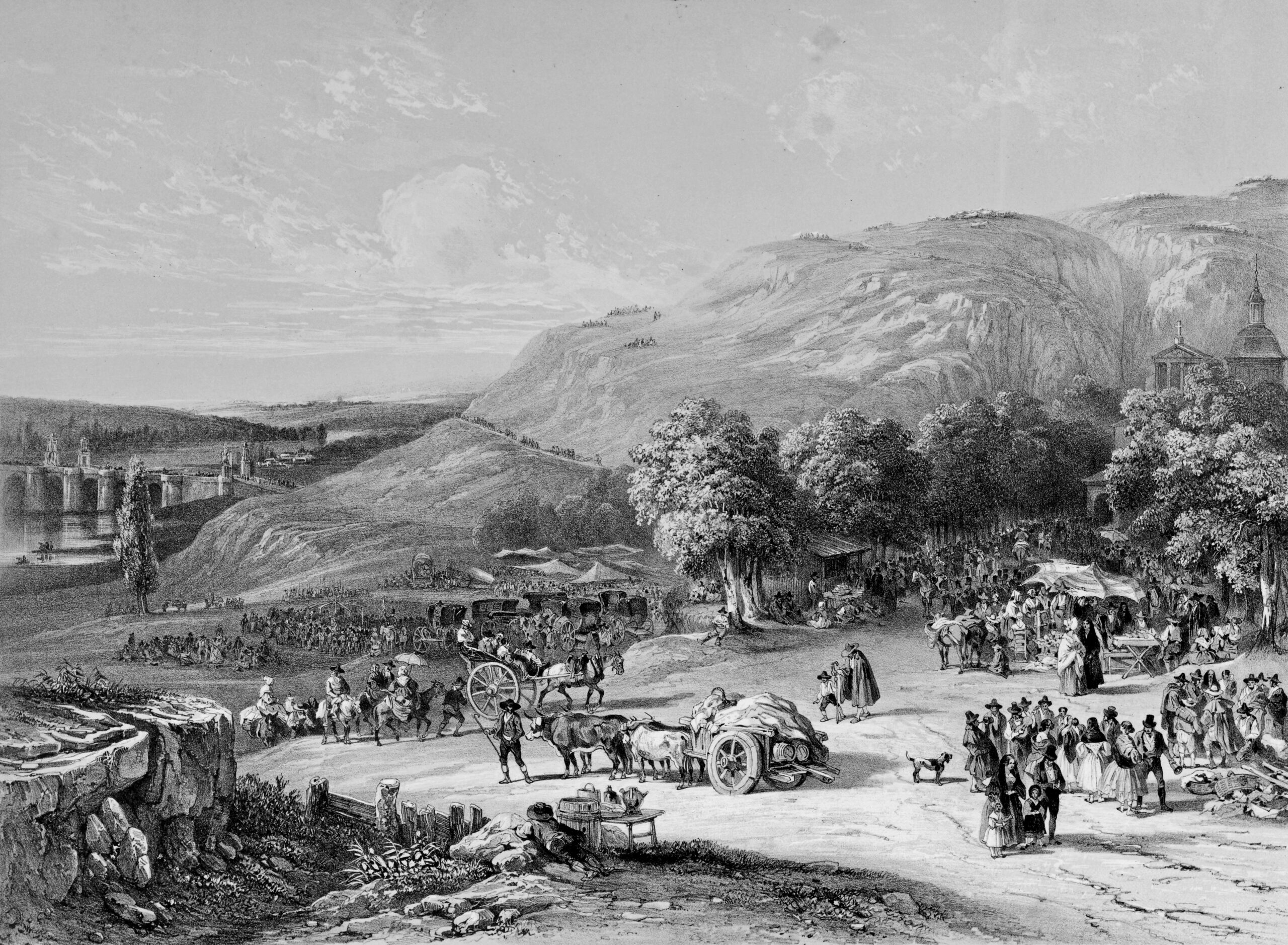
Romería de S. Isidro del Campo en Madrid
Louis-Julien Jacottet and Adolphe Jean-Baptiste Bayot after Genaro Pérez Villaamil, 1842
Lithograph
San Isidro is the patron saint of Madrid, and the romería or pilgrimage in his honour takes place annually on 15 May in the district of Carabanchel on the south bank of the river Manzanares. Like many saints’ feast days, a romería is both an act of veneration and an excuse for a day out. Legend has it that in the eleventh century Isidro, known as El Labrador—the labourer or farmer—was hired by the wealthy Madrid landowner Juan de Vargas to dig a well on his estate. The water from the spring he struck was found to have medicinal properties. In 1528, the Empress Isabel of Portugal, wife of Charles V, ordered the construction of a new chapel next to the fountain when the Emperor and their son, the future King Philip II, were cured of their ailments after taking the waters.
This view was taken in the afternoon of the day before the romería proper. In the commentary accompanying the image, Escosura recommended this time, when preparations were in train and the area was not so crowded. The view is towards the north east, with the river and the Bridge of Toledo centre-left (see 4.4). The church is just visible centre-right, but the main focus is the activity in the middle ground. Escosura emphasizes the pleasure the madrileños get from leaving behind their crowded streets and lying on the grass and enjoying themselves ‘estrepitosamente a la antigua manera española’ [boisterously, in the old Spanish manner]. He admits that the party doesn’t always end peacefully: punches are sometimes thrown and knives are drawn, but the fuerza pública (a public police force) intervenes quickly and efficiently.
There are two earlier takes on this scene, at least one of which may have been known to Villaamil. In 1788 Goya painted a cartoon, La pradera de San Isidro, for a tapestry destined for the Pardo palace but which was never made. The scene is from a similar viewpoint but looking north west and dominated in the foreground by fashionable majos and majas in bright, eye-catching clothes and parasols. Over thirty years later, during the political turmoil of the early 1820s, Goya would paint a much darker version of La romería de San Isidro, one of the so-called ‘Black Paintings’, on the walls of his house at the Quinta del Sordo, not far from the site of the miracle, in Carabanchel.
Title: Romería de S. Isidro del Campo en Madrid |Fête de S. Isidro del Campo à Madrid.
Author/Artist: Louis-Julien Jacottet (1806-1880) and Adolphe Jean-Baptiste Bayot (1810-1866, lithographers) after Genaro Pérez Villaamil (1807-1854, artist).
Technique and Material: Lithograph on paper.
Dimensions: 280 x 385 mm (image), 525 x 375 mm (page).
Published: Plate 12 from Genaro Pérez Villaamil and Patricio de la Escosura. España artística y monumental. Three volumes. Paris: A Hauser, 1842-50. Volume 1.
Date: 1842.
Marks and Inscriptions: lower edge, left: ‘G. P. de Villa-amil pinxit’ / ‘Paris, chez A. Hauser, Bould. des Italiens, 11.’; centre: title as above / ‘Costumbres Españolas | Mœurs Espagnoles’; right: ‘Lith. par Jacottet et Bayot.’ / ‘Imp. Lemercier, Benard & Cie. à Paris’.
Institution: Barry Ife Collection.
Click to zoom and pan
...
Your feedback is very important to us. Would you like to tell us why?
We will never display your feedback on site - this information is used for research purposes.
Details
Title
Romería de S. Isidro del Campo en Madrid.
Artist
Louis-Julien Jacottet and Adolphe Jean-Baptiste Bayot after Genaro Pérez Villaamil (1809-1854) .
Date
1842.
Medium and Support
Lithograph on paper.
Dimensions
280 x 385 mm (image), 525 x 375 mm (page).
Marks and Inscriptions
lower edge, left: ‘G. P. de Villa-amil pinxit’ / ‘Paris, chez A. Hauser, Bould. des Italiens, 11.’; centre: title as above / ‘Costumbres Españolas | Mœurs Espagnoles’; right: ‘Lith. par Jacottet et Bayot.’ / ‘Imp. Lemercier, Benard & Cie. à Paris’.
Institution
Barry Ife Collection
Plate 12 from Genaro Pérez Villaamil and Patricio de la Escosura. España artística y monumental. Three volumes. Paris: A Hauser, 1842-50. Volume 1.