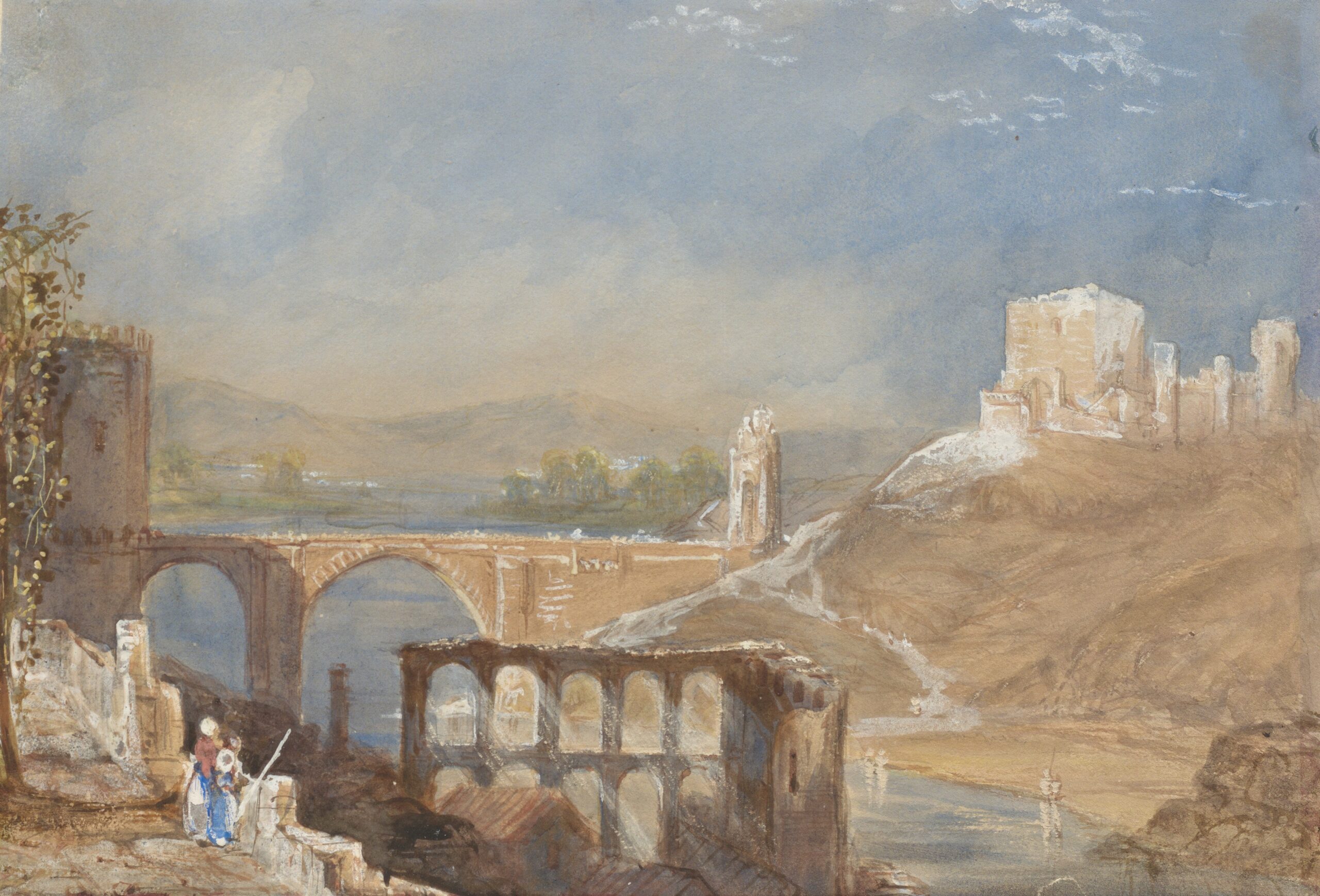
Toledo, Puente de Alcántara y Castillo de San Servando
Richard Ford, after 1833
Watercolour
The Castle of San Servando began to take its present form in the late eleventh century when Alfonso VI of León and Castile recaptured the city of Toledo from Muslim rule in 1085. He and his queen, Constance of Burgundy, rebuilt the monastery that had existed on the site since the seventh century, established the Benedictine order there and endowed the basilica as a means of defending Christian interests in the region. The monastery was destroyed by the North African Almoravid forces in 1110, who invaded the peninsula in 1086 to help the Iberian Muslims repel the Christian armies from the north. The Knights Templar were established in the monastery under Alfonso VIII of Castile (1155-1214). They rebuilt the monastery as a fortress to protect the bridge from further Muslim attacks. The building is now a youth hostel.
San Servando is named after the Spanish martyr Servandus who was beheaded for his Christian faith in Cádiz during the reign of the Roman Emperor Diocletian. He is said to have been buried in Seville. Richard Ford knew the castle as the ‘Castle of Cervantes’ but there is no known association with Cervantes and the error may have been the result of a mishearing of the contraction ‘San Servan’ which is how the name appears in the medieval epic Poema de Mio Cid.
This view is from the east bank of the river, looking southwards with the castle on the high ground to the left and the triumphal arch of 1721 clearly visible. The ruined arches in the foreground are the remains of a hydraulic system designed to raise water from the river to the Alcázar, built in 1565 by the Italian engineer Juanelo Turriano (Gianello della Torre, c. 1500-1585) during the reign of Philip II. The device is mentioned in Cervantes’s novella La ilustre fregona as one of the sights of Toledo. It operated satisfactorily until the middle of the seventeenth century when it failed due to lack of maintenance and theft of parts.
Title: Toledo, Puente de Alcántara y Castillo de San Servando.
Author/Artist: Richard Ford (1796-1858, artist).
Technique and Material: Watercolour on paper.
Dimensions: 170 x 245 mm.
Published: N/A.
Date: After 1833.
Marks and Inscriptions: None.
Institution: Ford Family Collection.
Click to zoom and pan
...
Your feedback is very important to us. Would you like to tell us why?
We will never display your feedback on site - this information is used for research purposes.
Details
Title
Toledo, Puente de Alcántara y Castillo de San Servando.
Artist
Richard Ford (1796-1858).
Date
After 1833.
Medium and Support
Watercolour on paper.
Dimensions
170 x 245 mm.
Marks and Inscriptions
None.
Institution
Ford Family Collection