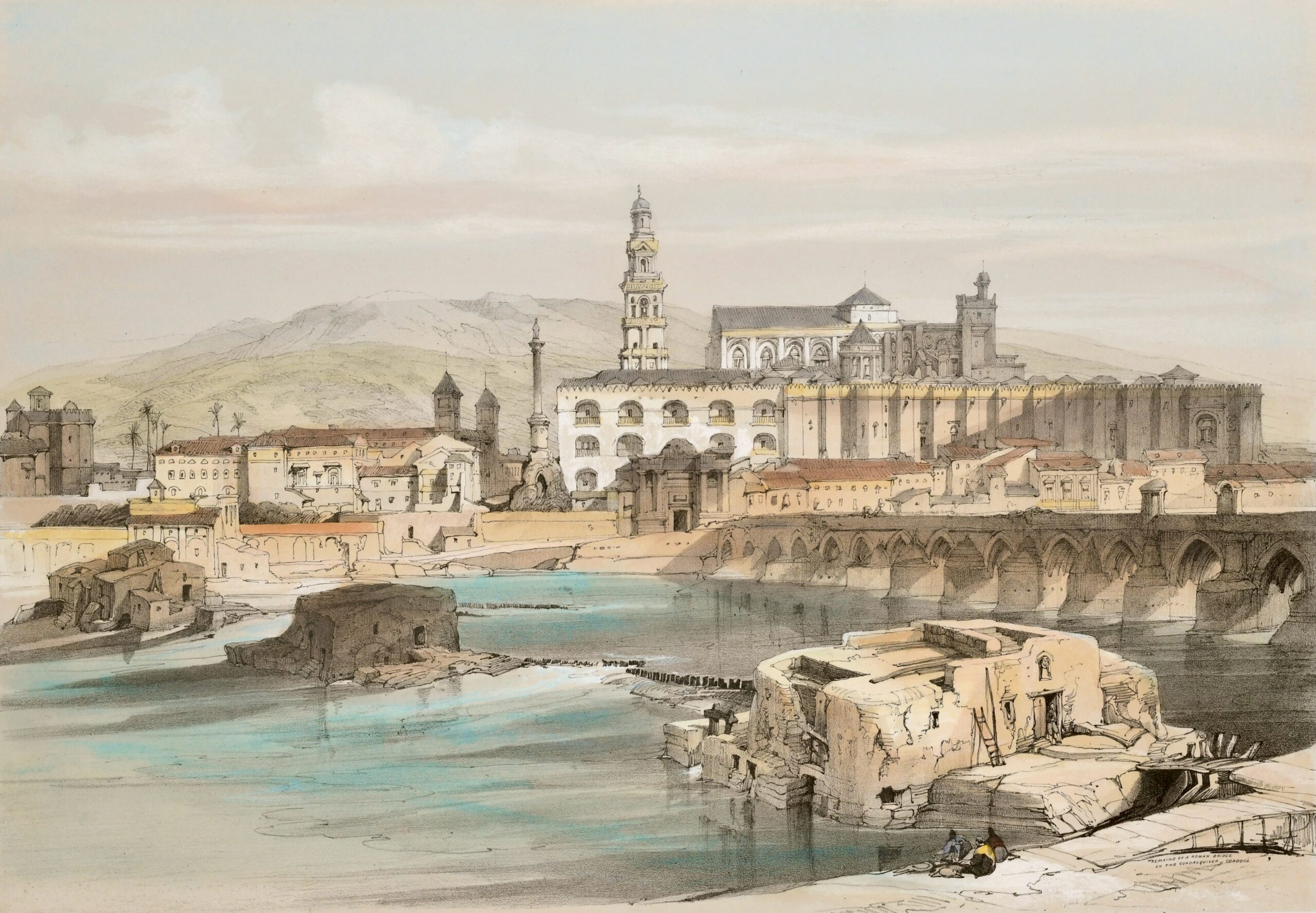
Mill and Bridge on the Guadalquivir, Cordova
Thomas Sidney Cooper after David Roberts, 1837
Hand-coloured lithograph
This lithograph depicts Córdoba from the southern bank of the Guadalquivir river. On the right, the Roman stone bridge spans the river, leading to the Renaissance gate (Puerta del Puente) on the northern bank. In the distance, the Mosque-Cathedral prominently defines the city’s outline. The view is based on one of the numerous sketches that Roberts made during his three-week sojourn in Córdoba from mid-January to early February 1833.
Roberts mostly focused his attention on the Mosque-Cathedral, but he also noted the city’s significant Roman heritage. Writing from Córdoba to a friend in Edinburgh, he reported that the city was the birthplace of the Roman philosopher Seneca and the poet Lucan. He was excited to discover ‘the finest remains of Roman architecture’ in this city, and that there was ‘scarcely a house in which Roman capitals, friezes, etc. are not built in the walls. Every gateway, every house facing a street or alley, is graced by a marble column, and in most places fluted. Here is a field of inquiry for antiquarians’. Conscious of the novelty of this subject matter for artistic representation, Roberts noted ‘The fact is that nothing is known of Spain; those who could have appreciated the richness of its architecture have generally gone to Italy or Greece. My portfolio is getting rich, the subjects are not only good, but of a very novel character. I begin to doubt whether I shall be able to paint half of them, they already amount to nearly 100, and I have yet six towns to visit’.1
Note:
1 James Ballantine, The Life of David Roberts, R.A. (Edinburgh: Adam and Charles Black, 1866), p. 47
Author/Artist: Thomas Sidney Cooper (1803-1902, lithographer) after a drawing by David Roberts (1796-1864).
Technique and Material: Lithograph, paper.
Size: 290 x 410 mm (image), 550 x 370 mm (page).
Published: Plate 22 from David Roberts, Picturesque sketches in Spain taken during the years 1832 & 1833. London: Hodgson & Graves, 1837.
Date: 1837.
Marks and Inscriptions: lower right: ‘Remains of a Roman Bridge on the Guadalquivir River’.
Institution: Collection Barry Ife.
Click to zoom and pan
...
Your feedback is very important to us. Would you like to tell us why?
We will never display your feedback on site - this information is used for research purposes.
Details
Title
Mill and Bridge on the Guadalquivir, Cordova.
Artist
Thomas Sidney Cooper (1803-1902).
Date
1837.
Medium and Support
Lithograph, paper.
Dimensions
290 x 410 mm (image), 550 x 370 mm (page).
Marks and Inscriptions
lower right: ‘Remains of a Roman Bridge on the Guadalquivir River’.
Previous Owners
Mill and Bridge on the Guadalquivir, Cordova
Thomas Sidney Cooper after David Roberts, 1837
Hand-coloured lithograph
This lithograph depicts Córdoba from the southern bank of the Guadalquivir river. On the right, the Roman stone bridge spans the river, leading to the Renaissance gate (Puerta del Puente) on the northern bank. In the distance, the Mosque-Cathedral prominently defines the city’s outline. The view is based on one of the numerous sketches that Roberts made during his three-week sojourn in Córdoba from mid-January to early February 1833.
Roberts mostly focused his attention on the Mosque-Cathedral, but he also noted the city’s significant Roman heritage. Writing from Córdoba to a friend in Edinburgh, he reported that the city was the birthplace of the Roman philosopher Seneca and the poet Lucan. He was excited to discover ‘the finest remains of Roman architecture’ in this city, and that there was ‘scarcely a house in which Roman capitals, friezes, etc. are not built in the walls. Every gateway, every house facing a street or alley, is graced by a marble column, and in most places fluted. Here is a field of inquiry for antiquarians’. Conscious of the novelty of this subject matter for artistic representation, Roberts noted ‘The fact is that nothing is known of Spain; those who could have appreciated the richness of its architecture have generally gone to Italy or Greece. My portfolio is getting rich, the subjects are not only good, but of a very novel character. I begin to doubt whether I shall be able to paint half of them, they already amount to nearly 100, and I have yet six towns to visit’.1
Note:
1 James Ballantine, The Life of David Roberts, R.A. (Edinburgh: Adam and Charles Black, 1866), p. 47
Author/Artist: Thomas Sidney Cooper (1803-1902, lithographer) after a drawing by David Roberts (1796-1864).
Technique and Material: Lithograph, paper.
Size: 290 x 410 mm (image), 550 x 370 mm (page).
Published: Plate 22 from David Roberts, Picturesque sketches in Spain taken during the years 1832 & 1833. London: Hodgson & Graves, 1837.
Date: 1837.
Marks and Inscriptions: lower right: ‘Remains of a Roman Bridge on the Guadalquivir River’.
Institution: Collection Barry Ife.
.Institution
Barry Ife Collection
Plate 22 from David Roberts, Picturesque sketches in Spain taken during the years 1832 & 1833. London: Hodgson & Graves, 1837.