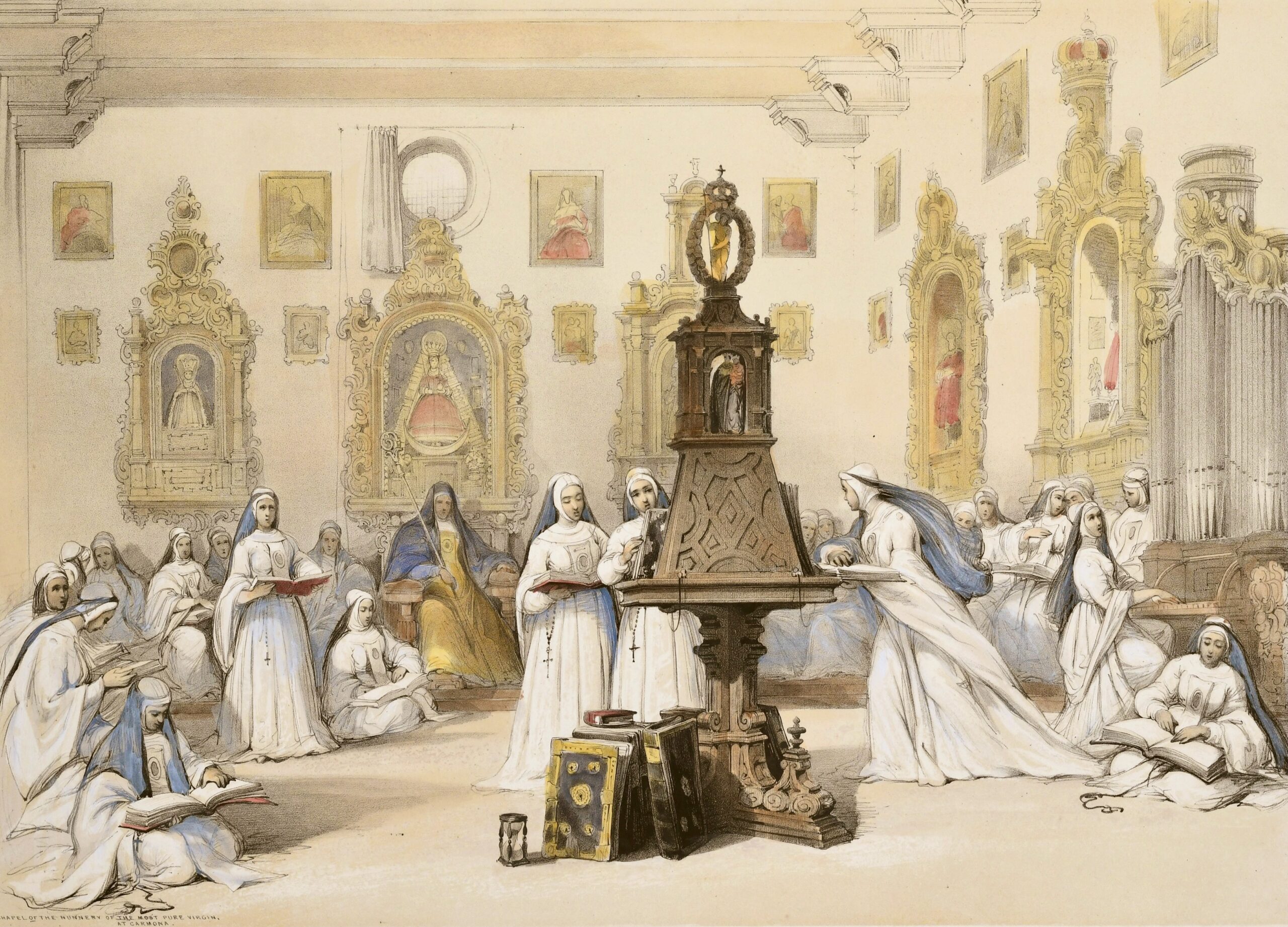
Chapel of the Nunnery of the Virgin at Carmona during the Service of the Vigils by the Holy Sisterhood
Louis Haghe after David Roberts, 1837
Roberts’s ethnographic interest in Spanish culture comes to the fore in this depiction of the ceremonial entry of a young girl into the community of nuns in a convent in Carmona. The lithograph is based on a watercolour drawing of 1834 (Scottish National Gallery).
The scene was also engraved for Thomas Roscoe’s popular book The Tourist in Spain. Andalusia (1836) with Roberts’s own commentary in which he emphasised the solemnity of the event while criticising it as a ‘heartless spectacle’ in a ‘gloomy convent’. Roberts’s disapproving remarks were common among British Protestant travellers. In Britain, anti-Catholic sentiment was being mobilised at the time by the question of the rights of Catholics. Ironically, the fiercest criticism came from the Spaniard Joseph Blanco White (1775-1841), a former priest who came to Britain during the Peninsular War and converted to Anglicanism. In his Letters of Spain (1822) and autobiography (1845), he offered a terrifying picture of Catholicism, including a sad account of young girls being manipulated into becoming nuns. Similarly, Roberts remarked that the ritual of taking the veil had ‘pierced’ his soul. ‘As she knelt before her associates—before those she had called her dearest friends from whom she was for ever cut off, the heart involuntarily shuddered at the cruelty committed under the name of religion—the holiest and sweetest ties for ever broken, the natural affection left to wither.’
As a male artist, Roberts described how he found it impossible not to look at ‘the lovely object kneeling before me’. The girl’s beauty reminded him of the female figures in the Baroque paintings of Seville artist Murillo. ‘Her eyes were Andalusian—full, round, and dark; the forehead high, spacious, and polished. There was a bewitching sweetness in her smile that was irresistible.’1 Such descriptions of southern Spanish women became common in travel writing and in art. Roberts’s commentary also drew attention to the nun’s cross-legged seating position, which he believed was an example of ‘Moorish customs still retained’. Spanish Catholicism is thus revealed as cruel and morbid, beautiful, sensual and exotic all at once.
Notes:
1 David Roberts quoted in Thomas Roscoe, The Tourist in Spain. Andalusia (London: Jennings & Co, 1836), pp. 180-181.
Title: Chapel of the Nunnery of the Virgin at Carmona during the Service of the Vigils by the Holy Sisterhood.
Author/Artist: Louis Haghe (1806-1885, lithographer) after a drawing by David Roberts (1796-1864).
Technique and Material: Hand-coloured lithograph, paper.
Size: 270 x 380 mm (image), 550 x 370 mm (page).
Published: Plate 15 from David Roberts, Picturesque sketches in Spain taken during the years 1832 & 1833. London: Hodgson & Graves, 1837.
Date: 1837.
Marks and Inscriptions: on the plate, lower left: ‘David Roberts 1833. Carmona’.
Institution: Barry Ife Collection.
Click to zoom and pan
...
Your feedback is very important to us. Would you like to tell us why?
We will never display your feedback on site - this information is used for research purposes.
Details
Title
Chapel of the Nunnery of the Virgin at Carmona during the Service of the Vigils by the Holy Sisterhood .
Artist
Louis Haghe (1806-1885).
Date
1837.
Medium and Support
Hand-coloured lithograph, paper.
Dimensions
270 x 380 mm (image), 550 x 370 mm (page).
Marks and Inscriptions
on the plate, lower left: ‘David Roberts 1833. Carmona’.
Institution
Barry Ife Collection
Plate 15 from David Roberts, Picturesque sketches in Spain taken during the years 1832 & 1833. London: Hodgson & Graves, 1837.