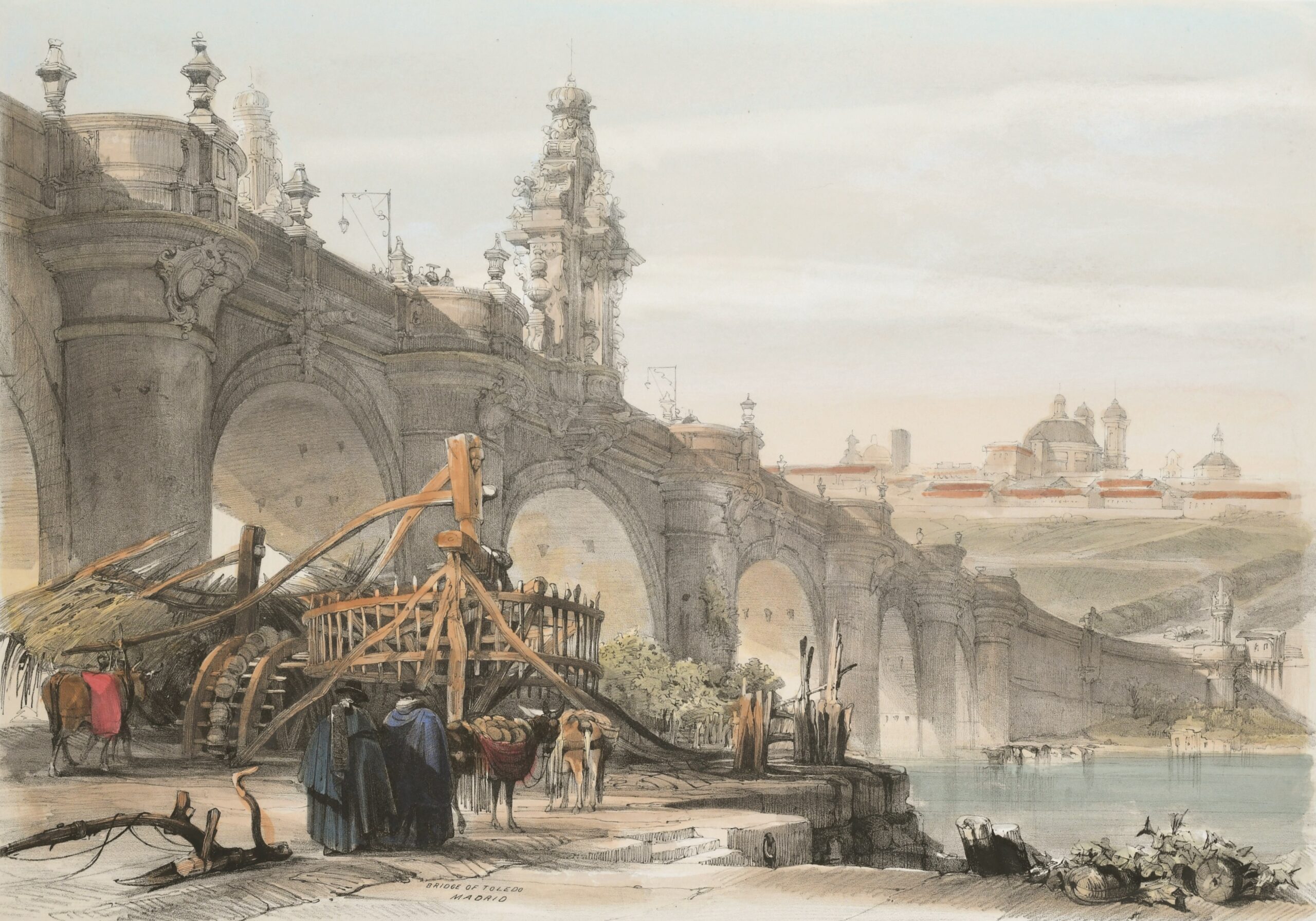
Bridge of Toledo, Madrid
Thomas Shotter Boys after David Roberts, 1837
Hand-coloured lithograph
The Bridge of Toledo, built by the Spanish architect Pedro de Ribera between 1718 and 1732, was in fact the third attempt to bridge the river Manzanares from central Madrid to the road to Toledo. The previous two bridges had been destroyed by floods in the 1660s and the 1680s and, not surprisingly, Ribera’s substantial Baroque design was built to last, which it has.
The central section of the bridge, seen here, has nine arches springing from massive pillars topped by balconettes, with a carriageway, now pedestrianised, that was just under five metres wide. In the centre are two ornate niches containing statues of the patron saints of Madrid, San Isidro and Santa María de la Cabeza made by Juan Alonso Villabrille y Ron in 1723. Roberts has been careful to show that the bridge benefitted from street lighting, though it is not clear how this was done, since gas lighting was not introduced in Madrid until the 1850s and electric light not till 1882. The bridge was declared a Monument of Cultural Interest in 1956 and has been the subject of extensive restoration to retain its solid but graceful presence in today’s traffic-free riverside promenades and gardens.
Roberts does full justice to the bridge’s original height, but undercuts the structure’s urban grandeur with a more rural note: the waterwheel (noria) of Arabic origin, with its draught animals, and the plough. The result is an intriguing dialogue between ancient and modern, rus in urbe. The waterwheel functions as a device of the Picturesque and also appears in other lithographs of his Picturesque Sketches: the Distant View of the Palace of the Escorial (3.7) and the Mill and Bridge on the Guadalquivir, Cordova (6.3) and relates to a watercolour sketch he made while in Málaga (private collection). The discarded timbers to the right of the steps down to the river could be a reference to the piles of the two earlier bridges that failed, some of which have been revealed in excavations for the M30 highway.
Roberts stayed for three weeks in Madrid between 16 December 1832 and 9 January 1833. He felt ambivalent about the capital. He preferred Burgos, where he had spent a week sketching the Gothic cathedral before arriving in the capital. In Madrid, he disliked the food and the cold winter. However, he was impressed by the Prado Museum’s collection of paintings and sketched a number of urban views of Madrid. Apart from the one shown here, he depicted the Puerta de Alcalá and several monumental fountains built as part of the city’s eighteenth-century urban reforms.
Title: Bridge of Toledo, Madrid.
Author/Artist: Thomas Shotter Boys (1803- 1874, lithographer) after David Roberts (1796-1864, artist).
Technique and Material: Hand-coloured lithograph on paper.
Dimensions: 280 x 395 mm (image), 550 x 370 mm (page).
Published: Plate 20 from David Roberts, Picturesque sketches in Spain taken during the years 1832 & 1833. London: Hodgson & Graves, 1837.
Date: 1837.
Marks and Inscriptions: On the plate, bottom centre: ‘Bridge of Toledo Madrid’.
Institution: Barry Ife Collection.
Click to zoom and pan
...
Your feedback is very important to us. Would you like to tell us why?
We will never display your feedback on site - this information is used for research purposes.
Details
Title
Bridge of Toledo, Madrid.
Artist
Thomas Shotter Boys (1803-1874) after David Roberts (1796-1864) .
Date
1837.
Medium and Support
Hand-coloured lithograph on paper.
Dimensions
280 x 395 mm (image), 550 x 370 mm (page).
Marks and Inscriptions
On the plate, bottom centre: ‘Bridge of Toledo Madrid’.
Institution
Barry Ife Collection
Plate 20 from David Roberts, Picturesque sketches in Spain taken during the years 1832 & 1833. London: Hodgson & Graves, 1837.