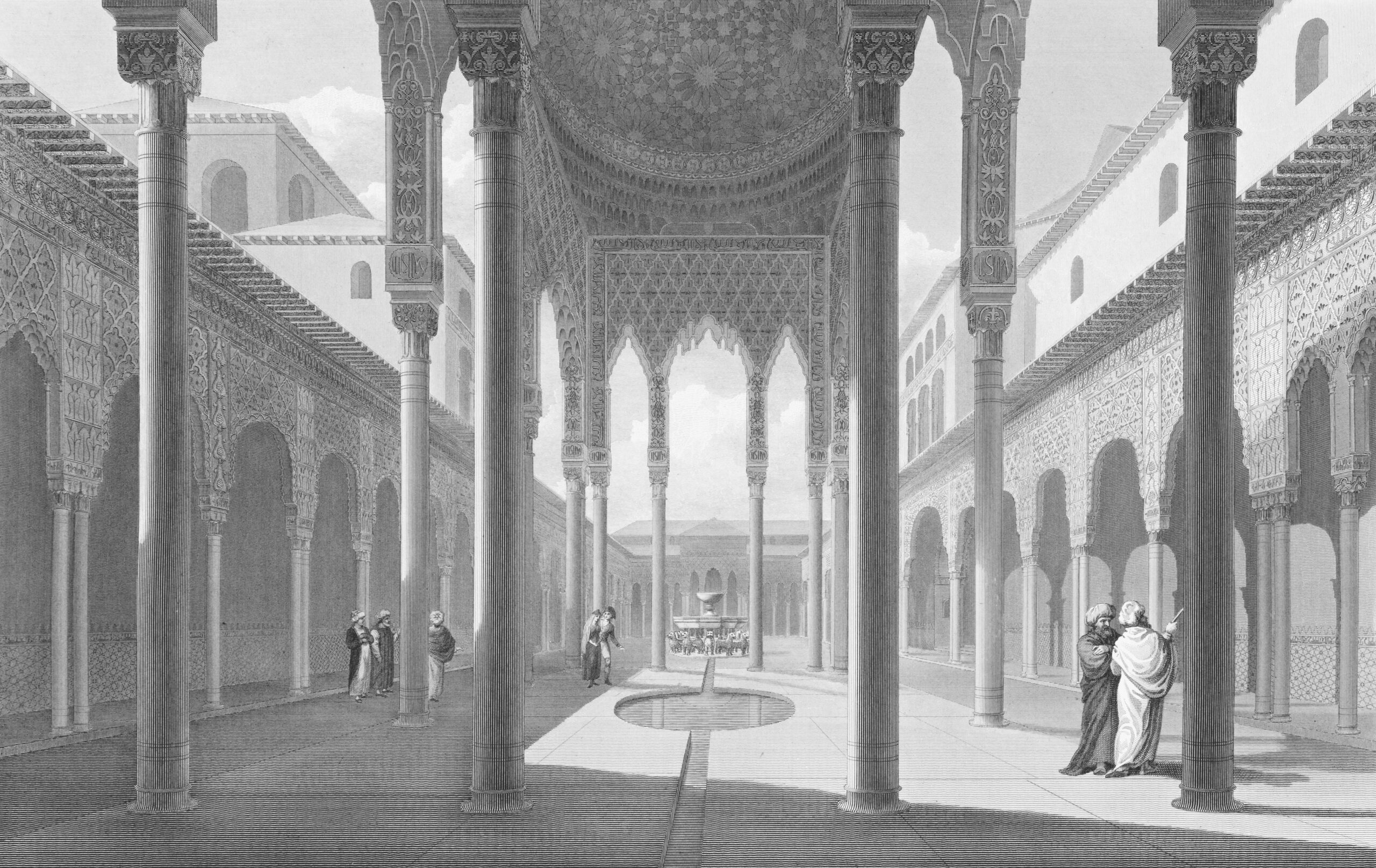
Court of the Lions, Alhambra
Samuel Porter after James C. Murphy, 1815
Line engraving
This plate shows a perspectival view of the Court of the Lions through the arches of the east pavilion, with the emblematic fountain in the distance. The proportions of the space have been greatly exaggerated to make the architecture more awe-inspiring. The arches appear to be elongated, almost resembling a lofty Gothic structure. Small figures wearing Arab dress serve to remind the viewer of the original inhabitants of the palace and to emphasis the vastness of the space. In reality the courtyard is compact in size (28 x 16 m).
The view is by James Cavanagh Murphy, an Irish architect, who was in Spain between 1802 and 1809, studying its Islamic heritage. He was aided by the pioneering two-volume Antigüedades Árabes (1780, 1802), the first survey of the Alhambra and the Mosque-Cathedral of Córdoba, published by the Real Academia de Bellas Artes de San Fernando. After settling in England, Murphy prepared his own publication, The Arabian Antiquities of Spain, the first publication in English to provide a comprehensive overview of the Alhambra and Córdoba’s Mosque-Cathedral through plans, sections and elevations, and ornamental details. Despite Murphy’s intention to reveal the architecture accurately, Murphy tended to gothicise the interior spaces, as shown in this print. This approach catered to the aesthetic concept of the Sublime and resonated with the (now dismissed) theory that the Gothic style partly derived from Islamic architecture.
In his introduction, Murphy contrasted the ‘very high state of excellence to which the Spanish Arabs attained in the Fine Arts’ with the ‘ignorance and barbarism’ of the rest of medieval Europe. Murphy’s esteem for Islamic Spain was echoed in the companion book to his publication, The History of the Mahometan Empire in Spain (1815) by John Shakespear and the Biblical scholar Hartwell Horne. They offered a historical survey of the achievements of the Iberian Arabs in all fields of knowledge—science, astronomy, architecture, philosophy and literature. They concluded that the medieval Arabs had been judged unfairly as a warlike people when, in fact, modern civilization was indebted to them for many of the useful inventions that Europe had been enjoying for centuries. Such positive views of Islamic Spain were shared by most artists and writers travelling in Spain in the nineteenth century.
Click to zoom and pan
...
Your feedback is very important to us. Would you like to tell us why?
We will never display your feedback on site - this information is used for research purposes.
Details
Title
Court of the Lions, Alhambra.
Artist
Samuel Porter (fl. 1792?-1842?) after James Cavanah Murphy (1760-1814) .
Date
1815.
Published
Plate 33, from Arabian Antiquities of Spain,London, 1815, vol. 1.
Medium and Support
Line engraving, paper.
Dimensions
409 x 563 mm (double page).
Marks and Inscriptions
On the plate below the image, lower edge, left: ‘J. C. Murphy delt.’; centre: title as above / ‘London. Published by Cadell and Davies. June 1st. 1815.’; right: ‘Engraved by S. Porter’.
Institution
Private collection