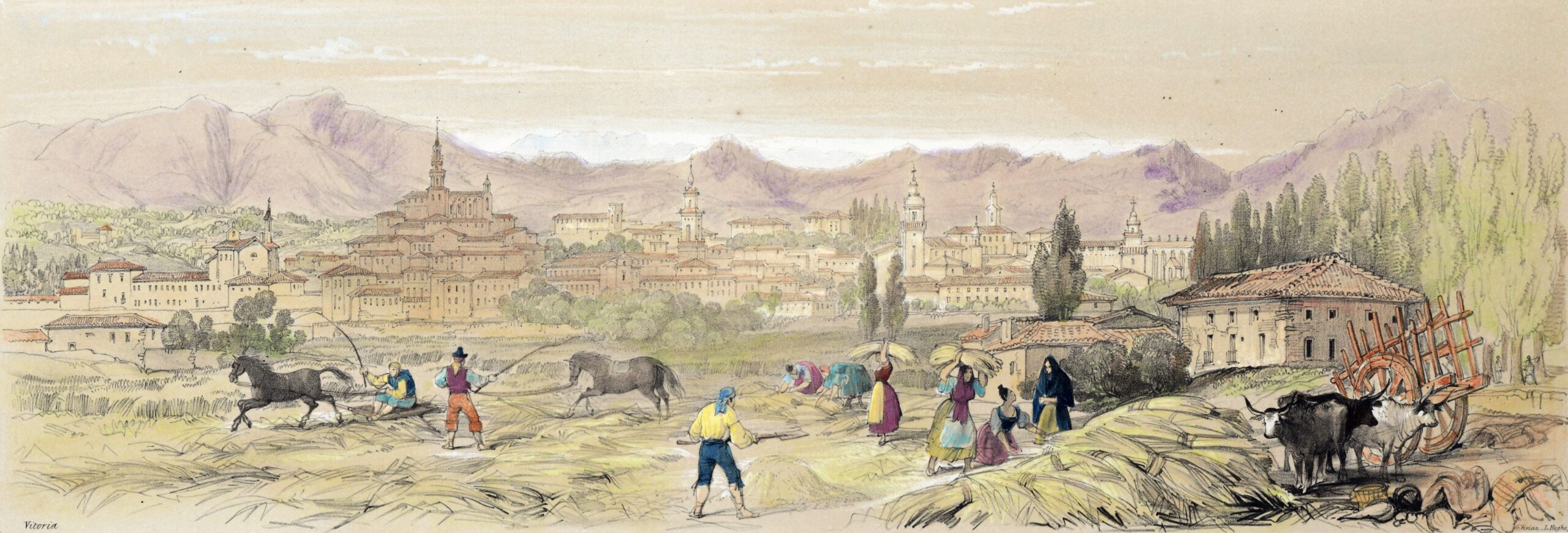
Vitoria
Louis Haghe after George Vivian, 1838
Hand-coloured lithograph
Although we do not have precise information about the route that George Vivian took on his first visit to Spain in 1833, it is possible to deduce it from the images he published in 1838 and 1839. In 1833 he seems to have taken Joseph Townsend’s advice and travelled via Bayonne in south west France, where he visited the site of the Chateau de Marracq. The chateau had burned down in 1825 but before that had been Napoleon’s headquarters during the Peninsular War. It was there that he received the abdication of Charles IV and Ferdinand VII in 1808 before installing his brother Joseph as King of Spain. From Bayonne, Vivian travelled to St Jean de Luz, San Sebastián, Biscay, Bilbao, Vitoria, Burgos, Palencia, Valladolid, Segovia, El Escorial and Madrid before heading east to Valencia.
Since Vitoria is something of a detour, Vivian was evidently keen to see the site of the Battle of Vitoria (1.7, 1.9), perhaps because of a possible family connection: Sir Richard Hussey Vivian (1775-1842), later Lord Vivian, who distinguished himself by fighting under Wellington in the Peninsular War and later at Waterloo. The precise relationship has not so far been established, but George Vivian did not need a war hero in the family to encourage him to visit the sites of some of the most famous battles.
Vivian’s image of peaceful rural endeavour owes a great deal to his lithographer, Louis Hague, as Vivian’s original sketch (now in the Biblioteca Nacional, Madrid) has no figures in the foreground. The results of their collaborative efforts show little trace of the mortal conflict that took place there only 20 years earlier, but the scene is nevertheless freighted with memory. As Edward Hawke Locker wrote: ‘The heart of an Englishman beats with unusual vivacity as he approaches Vittoria. Every object reminds him of the triumph of his countrymen, while imagination is busy, repeopling the plain with the crowd of combatants, who, only a few months before my visit, had mingled in the desperate strife of arms on the soil still imprinted with their struggles.’
Title: Vitoria.
Author/Artist: Louis Haghe (1806-1885, lithographer) after George Vivian (1798-1873, artist).
Technique and Material: Hand-coloured lithograph.
Dimensions: 130 x 385 mm (image) 550 x 365 (page); there are two images on this page.
Published: Plate 9 from George Vivian, Spanish Scenery. London: P & D Colnaghi, 1838.
Date: 1838.
Marks and Inscriptions: on the plate, bottom left: ‘Vitoria’; right: ‘G Vivian L Haghe’.
Institution: Barry Ife Collection.
Click to zoom and pan
...
Your feedback is very important to us. Would you like to tell us why?
We will never display your feedback on site - this information is used for research purposes.
Details
Title
Vitoria.
Artist
Louis Haghe (1806-1885).
Date
1838.
Dimensions
130 x 385 mm (image) 550 x 365 (page); there are two images on this page.
Marks and Inscriptions
on the plate, bottom left: ‘Vitoria’; right: ‘G Vivian L Haghe’.
Institution
Barry Ife Collection
Plate 9 from George Vivian, Spanish Scenery. London: P & D Colnaghi, 1838. Date: 1838.